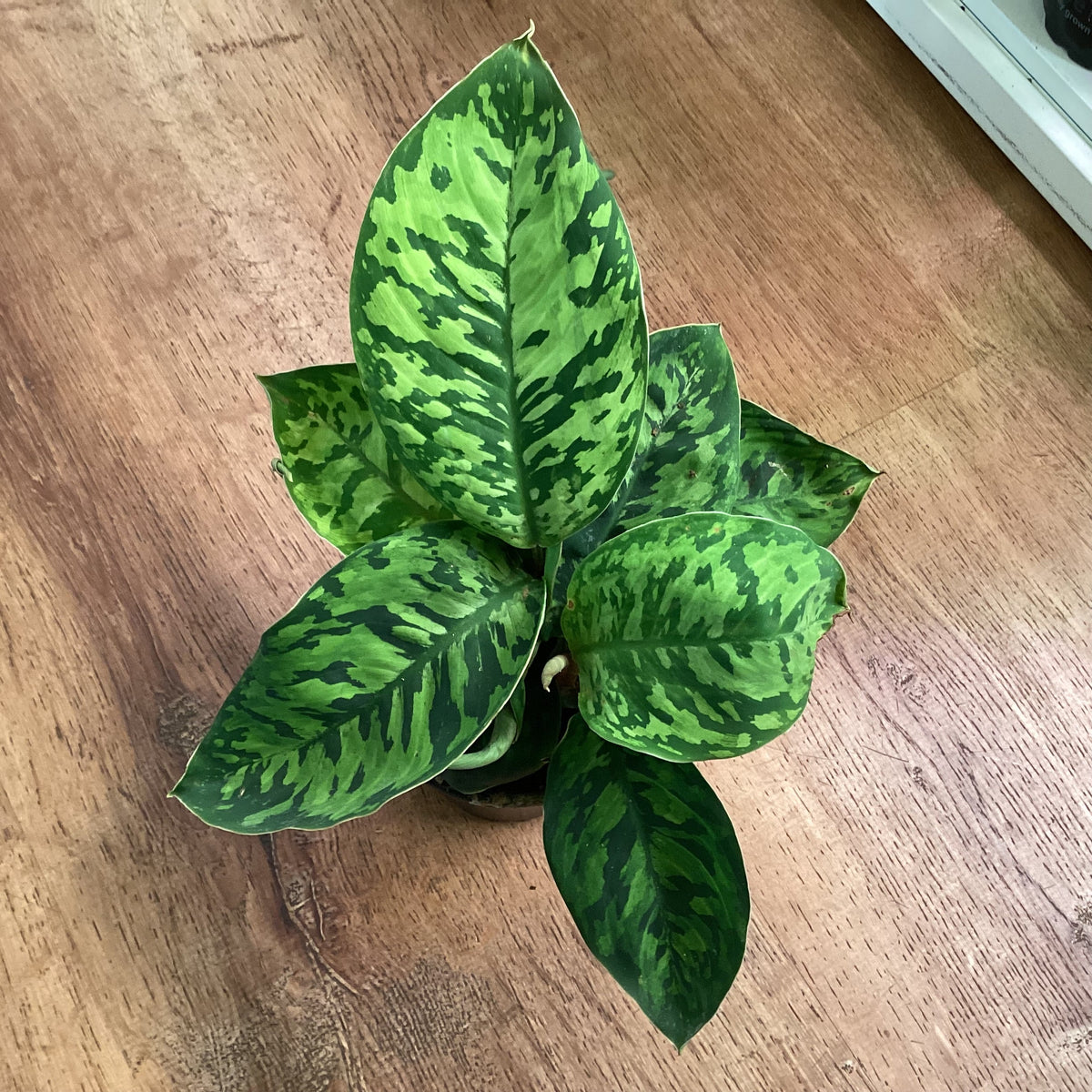
Homalomena wallisii ‘Camouflage’
Homalomena wallisii ‘Camouflage’
Couldn't load pickup availability
‘Camouflage’ is a variegated selection of Adelonema wallisii, a terrestrial aroid native to the tropical forests of Colombia, Panama, and Venezuela. The species was historically placed in Homalomena, which explains the older name still found throughout the houseplant trade. Its foliage emerges from a low, clumping base, gradually forming a dense mound of broad, tapered leaves. The irregular green-on-green pattern is integrated into the leaf tissue rather than appearing as unstable white variegation, allowing the plant to retain a lush, vigorous character. Mature plants generally remain under approximately 18–24 inches indoors, making this a distinctive foliage plant for shelves, tables, and smaller interior spaces.
Light: Provide medium to bright, gentle light. An east-facing window or filtered south- or west-facing exposure is ideal. The plant tolerates moderate light, but growth may become sparse and its variegation less distinct. Avoid strong direct afternoon sun, which can bleach or scorch the leaves.
Water: Water thoroughly when the upper 1–2 inches of the growing medium begin to dry, then allow excess water to drain. This species prefers consistent moisture but is vulnerable to root and stem rot when kept saturated. Do not allow the entire root ball to become severely dry, since prolonged drought can cause drooping, curled leaves, and crisp margins.
Humidity: Average Bay Area household humidity is often sufficient, although approximately 50–70% supports fuller growth and cleaner leaf edges. San Francisco’s coastal conditions are generally favorable. A humidifier may be useful in heated rooms or warmer, drier parts of Oakland and San Jose. Humidity should always be paired with gentle air circulation.
Soil: Use a loose, moisture-retentive aroid mixture containing quality potting mix or coco coir, fine orchid bark, and perlite or pumice. The medium should remain lightly moist without becoming dense or muddy. A pot with unobstructed drainage is essential.
Temperature: Maintain approximately 65–85°F. Protect the plant from temperatures below 58°F, cold windows, exterior drafts, and abrupt temperature changes. It may grow outdoors in a sheltered, shaded Bay Area location during warm weather, but it should return indoors before cool autumn nights.
Growth Habit: ‘Camouflage’ is a compact, self-heading plant that expands through basal growth rather than climbing or trailing. Over time it forms a dense, upright clump. Mature dimensions vary with conditions, but commercial plants are commonly described as reaching approximately 12–24 inches tall. Division during repotting is the most dependable propagation method.
Variegation: Each leaf carries a unique mixture of light and dark green patterning. Color contrast may become less pronounced in low light, but harsh sun will not improve the pattern and may damage the foliage. Variation between leaves is normal and part of the cultivar’s character.
Fertilizer: Feed every four to six weeks during active growth with a balanced fertilizer diluted to approximately one-quarter to one-half strength. Apply fertilizer only to moist soil. Reduce or pause feeding when growth slows during the Bay Area’s cooler, darker months.
Flowers: Mature plants may produce small aroid inflorescences composed of a spadix enclosed by a greenish spathe. These are botanically interesting but visually secondary to the patterned foliage. Removing them is optional.
Pest Care: Check the leaf undersides and tightly clustered stems for spider mites, thrips, scale, and mealybugs. Wiping the broad leaves periodically removes dust and makes early pest activity easier to detect.
Pet Safety: Not pet-safe. Adelonema wallisii is not individually listed in the ASPCA plant database, but it belongs to the aroid family and should be treated as containing irritating calcium oxalate crystals. Chewing may cause oral pain, drooling, vomiting, and difficulty swallowing in cats and dogs. Keep it securely away from pets and small children.
Share