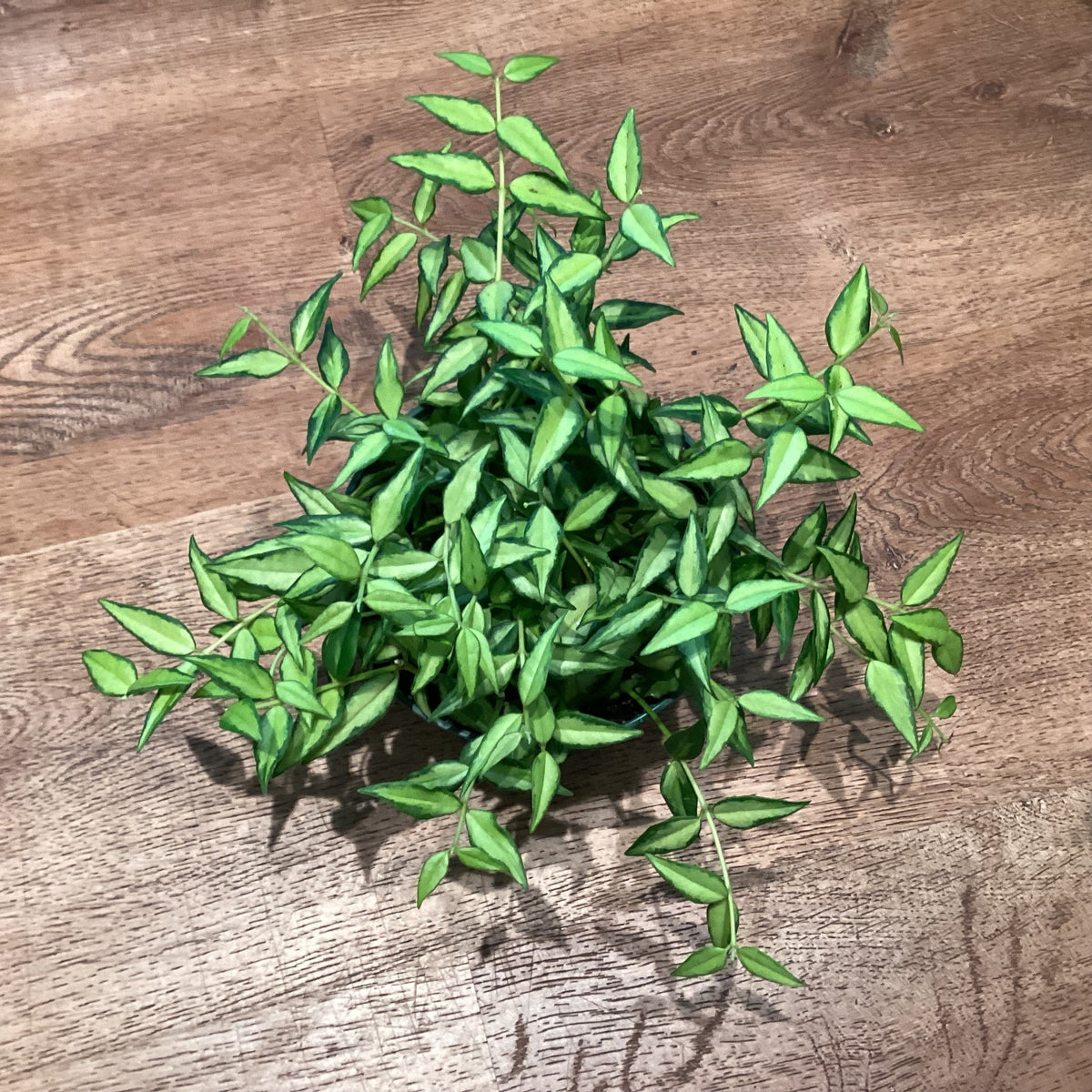
Hoya bella ‘Luis Bois’
Hoya bella ‘Luis Bois’
Couldn't load pickup availability
‘Luis Bois’ is the inner-variegated form of Hoya bella, distinguished by pale cream-to-yellow centers surrounded by narrow green margins. The central veins and young stems may blush pink or red, particularly under bright light. Because much of each leaf contains little chlorophyll, this cultivar grows more slowly and is less forgiving of drought, excessive sun, and root stress than standard Hoya bella. It is sometimes confused with ‘Anneke Buis’, the outer-variegated form, but the placement of the variegation makes the two immediately distinguishable. Mature stems produce elegant terminal umbels of white flowers with sharply contrasting rose-pink coronas.
Light: Provide abundant bright, gentle light to maintain strong variegation and compact growth. An east-facing window or filtered south- or west-facing exposure is ideal. Avoid intense midday sun, which can scorch the pale centers of the leaves. In lower light, growth may become sparse and flowering less reliable.
Water: Water when the upper portion of the growing medium begins to dry, but do not allow the plant to remain completely dry for long. Hoya bella has finer leaves and roots than many thick-leaved Hoyas and prefers more consistent moisture. At the same time, ‘Luis Bois’ is vulnerable to root rot, so the pot must drain freely and should never remain waterlogged.
Humidity: Aim for moderate to high humidity, ideally around 50–70%, with gentle air circulation. Typical San Francisco and coastal Bay Area humidity is often adequate indoors. In warmer or drier parts of Oakland, San Jose, and the inland Bay Area, a nearby humidifier can help protect tender new growth and support flowering.
Soil: Use a fine but airy epiphytic mixture that retains some moisture without becoming dense. Fine orchid bark, coco husk or coco coir, perlite, and a small amount of quality potting mix or sphagnum work well. Avoid an excessively coarse mix that dries before the delicate roots can take up sufficient water. A modestly sized pot is preferable to an oversized container.
Temperature: Keep between approximately 60–80°F. Hoya bella generally appreciates slightly cooler conditions than many tropical Hoyas, making it particularly well suited to San Francisco homes. Protect it from temperatures below 50°F, cold drafts, and prolonged inland heat.
Growth Habit: This is a naturally pendant Hoya with slender, branching stems. Display it in a hanging basket or allow it to spill from a shelf rather than forcing it onto a rigid trellis. Pinching or lightly pruning young growth can create a fuller plant, but avoid frequent heavy pruning because flowers are formed near the ends of mature shoots.
Flowers: Mature plants produce hanging umbels of white, sharply pointed flowers with glossy pink-to-magenta centers and a light fragrance. Flowering is most likely with bright light, consistent moisture, and stable conditions. Unlike many familiar Hoyas, Hoya bella flowers from short-lived terminal flowering structures rather than repeatedly blooming from the same persistent peduncle, so it is normal for the spent flower cluster and its stalk to fall away.
Pest Care: Inspect the leaf axils, tender growing tips, and undersides of leaves for mealybugs, aphids, and spider mites. The pale portions of the foliage are easily marked, so isolate and treat infestations early with the gentlest effective method.
Pet Safety: Hoyas are generally regarded as non-toxic to cats and dogs.
Share