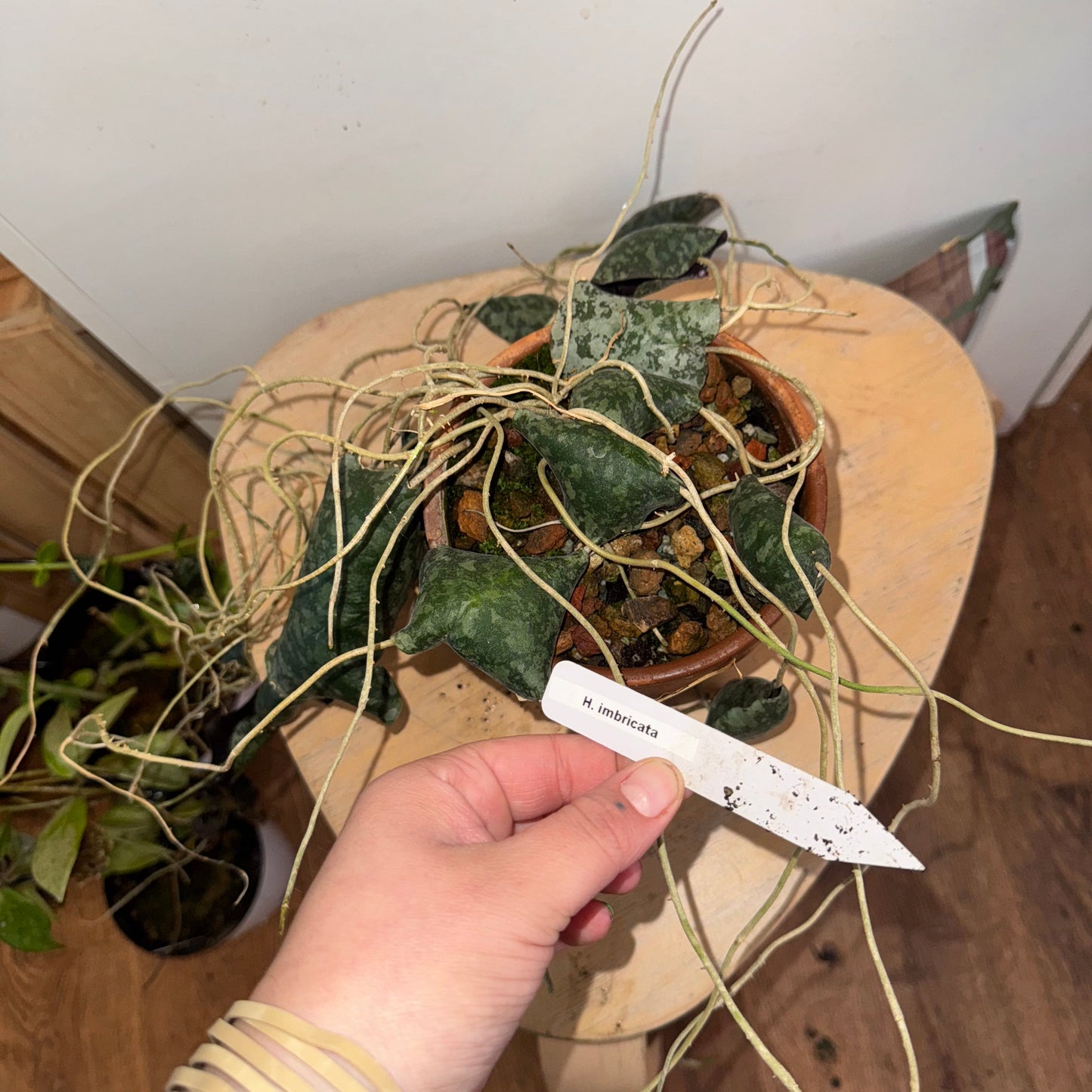
Hoya imbricata
Hoya imbricata
Couldn't load pickup availability
About Hoya imbricata
Native to Southeast Asia — including the Philippines, Borneo, and parts of Malaysia — Hoya imbricata was first described in the early 19th century. In the wild, it grows as an epiphyte, attaching itself to tree trunks and branches in tropical rainforests.
Unlike most trailing Hoyas, this species adapts to a very specific niche: it climbs and then flattens its leaves tightly against bark or other vertical surfaces. Beneath each leaf, it creates a hollow pocket — a microhabitat that often houses ants. This fascinating plant–ant relationship (a form of mutualism) helps protect the plant from herbivores and may even assist in nutrient acquisition.
Foliage
The leaves are large, round to oval, and shield-like, often mottled green with subtle patterning. When mounted properly, they overlap in an imbricating pattern (hence the name), creating a dramatic shingled effect across the surface.
If grown in a standard pot without a vertical surface, the plant may produce more typical vining growth — but its most iconic look happens when mounted.
Flowers
Clusters of small, star-shaped flowers emerge from the edges of leaves or in the crevices between leaf and mounting surface. Blooms are typically white to pale yellow and lightly fragrant. Like most Hoyas, flowers grow from persistent peduncles — do not remove them after blooming.
How to Grow Hoya imbricata
Light
Bright gentle light. Think dappled rainforest canopy. Avoid harsh direct sun, which can scorch the leaves.
Water
Keep evenly moist but never soggy. Allow the top layer of your medium to dry slightly between waterings. Mounted specimens will dry faster and need more frequent attention.
Humidity
High humidity is essential — ideally 70% or higher. This species thrives in greenhouses, grow cabinets, or naturally humid coastal climates. In places like coastal San Francisco, ambient humidity is often sufficient.
Temperature
Warm conditions are best: 65–85°F. Protect from cold drafts and avoid temperatures below 60°F.
Growing Medium
Because it’s epiphytic, it prefers a chunky, airy mix such as orchid bark, perlite, and a small amount of sphagnum or peat. Many growers mount it on cork bark or wood to replicate its natural growth habit — which also encourages the iconic shield formation.
Bloom Season
Blooms intermittently in warm, stable conditions. Flowering is more likely once the plant is well-established and receiving consistent humidity and light.
Pet Safety
Pet safe. (Hoyas are listed as non-toxic to cats and dogs according to the ASPCA.)
Share