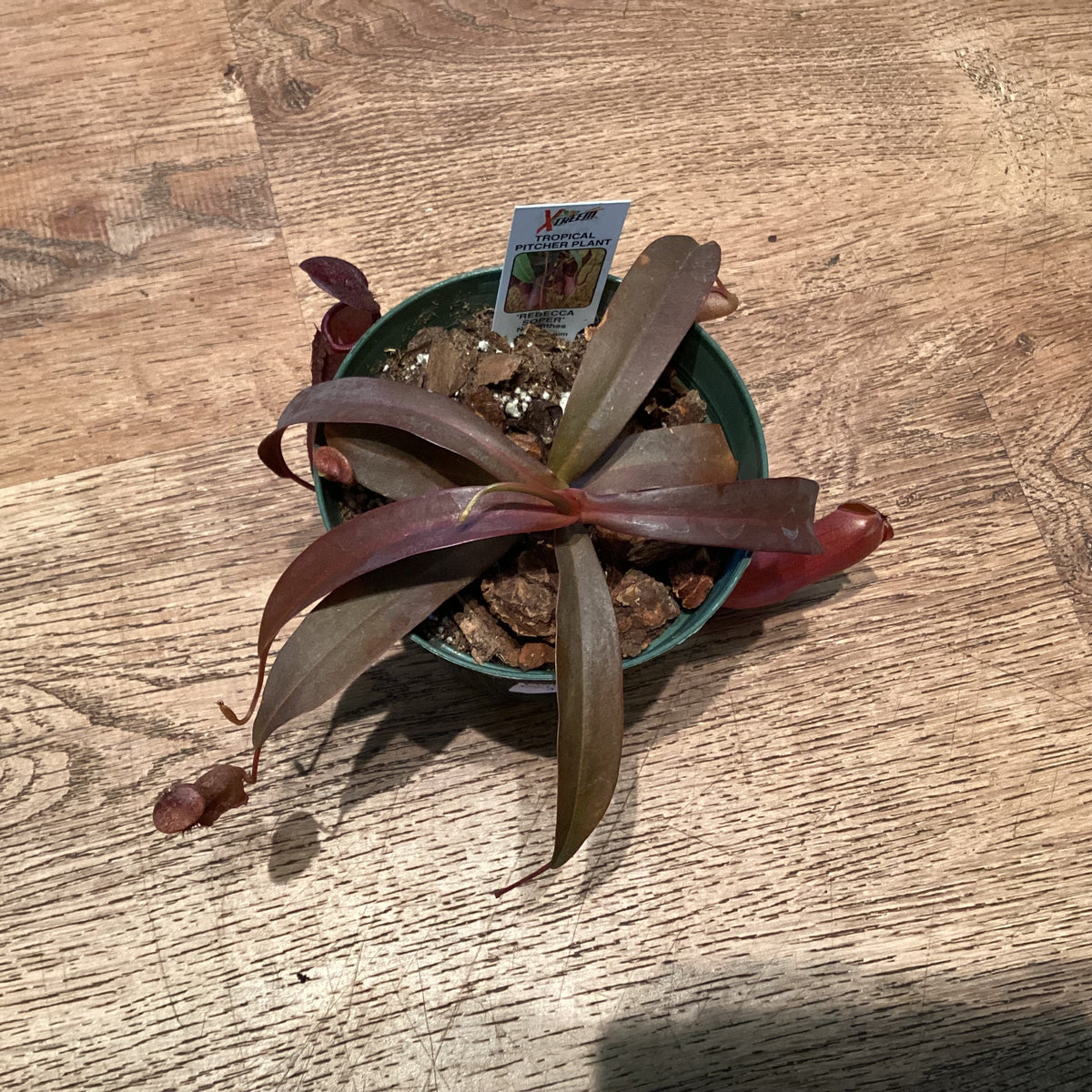
Nepenthes ‘Rebecca Soper’
Nepenthes ‘Rebecca Soper’
Couldn't load pickup availability
Nepenthes ‘Rebecca Soper’ is a vigorous tropical pitcher plant prized for its dramatic coloring. Deep burgundy leaves frame elegant, wine-red pitchers, creating an unusually dark and sculptural display. More adaptable than many collector Nepenthes, it is an excellent choice for a bright window, greenhouse cabinet, or sheltered Bay Area patio.
Light: Provide very bright, gentle light. A bright east- or south-facing window with some protection from intense afternoon sun is ideal. A few hours of mild morning or late-day sun will encourage darker foliage and pitchers. Acclimate gradually, since leaves grown in lower light can scorch if moved abruptly into direct sun.
Water: Keep the growing medium consistently moist but never waterlogged. Water thoroughly when the surface begins to feel only slightly less damp, then allow excess water to drain completely. Do not leave the pot standing in a tray of water. Use rainwater, distilled water, reverse-osmosis water, or another reliably low-mineral source. San Francisco’s Hetch Hetchy water is relatively soft and is often suitable, although distilled or reverse-osmosis water remains the safest choice where water quality is uncertain.
Humidity: Average household humidity may keep this adaptable hybrid alive, but approximately 50–70% humidity encourages more reliable pitcher production. Kitchens, bright bathrooms, greenhouse cabinets, and naturally humid San Francisco homes can work especially well. In warmer, drier parts of Oakland and the inland Bay Area, a humidifier may be helpful. Good light and consistent watering are more effective than occasional misting.
Soil: Grow in a loose, nutrient-poor, acidic medium with excellent airflow around the roots. Long-fiber sphagnum moss mixed with perlite and fine orchid bark is a dependable choice. Never use ordinary potting soil, compost, or mixes containing added fertilizer. Repot only when the medium begins to compact or decompose, handling the fine roots gently.
Temperature: This hybrid appreciates intermediate conditions, with warm days around 70–82°F and cooler nights around 55–68°F. It tolerates ordinary indoor temperatures well, particularly when nights are slightly cooler. Protect it from frost, cold drafts, and prolonged heat above approximately 90°F. Coastal Bay Area conditions are naturally favorable, while plants kept outdoors in warmer inland areas need protection from afternoon heat and drying wind.
Feeding: The pitchers catch insects on their own and do not require conventional soil fertilizer. Indoor plants may occasionally be given a small insect or a very dilute, carnivorous-plant-appropriate foliar feeding during active growth. Do not place meat or human food inside the pitchers.
Pitchers: New tendrils may stop developing if the plant experiences sudden changes in light, humidity, temperature, or location. Existing pitchers also naturally brown and die with age. Consistent conditions are the key to regular pitcher production. If a pitcher is empty, a small amount of distilled water may be added, but do not fill it more than about one-third full.
Growth Habit: Nepenthes are tropical vines. Young plants form compact rosettes, then gradually develop climbing stems that can be allowed to trail or trained onto a support. Pruning a long vine can encourage basal shoots and a fuller plant. This cultivar has no winter dormancy, although growth may slow during the Bay Area’s darker winter months.
Pet Safety: Nepenthes is not generally regarded as poisonous to cats or dogs, but the genus does not have a specific entry in the ASPCA toxic and non-toxic plant database. Keep it out of reach of pets that chew plants, since ingesting plant material or pitcher fluid could still cause irritation or digestive upset.
Share