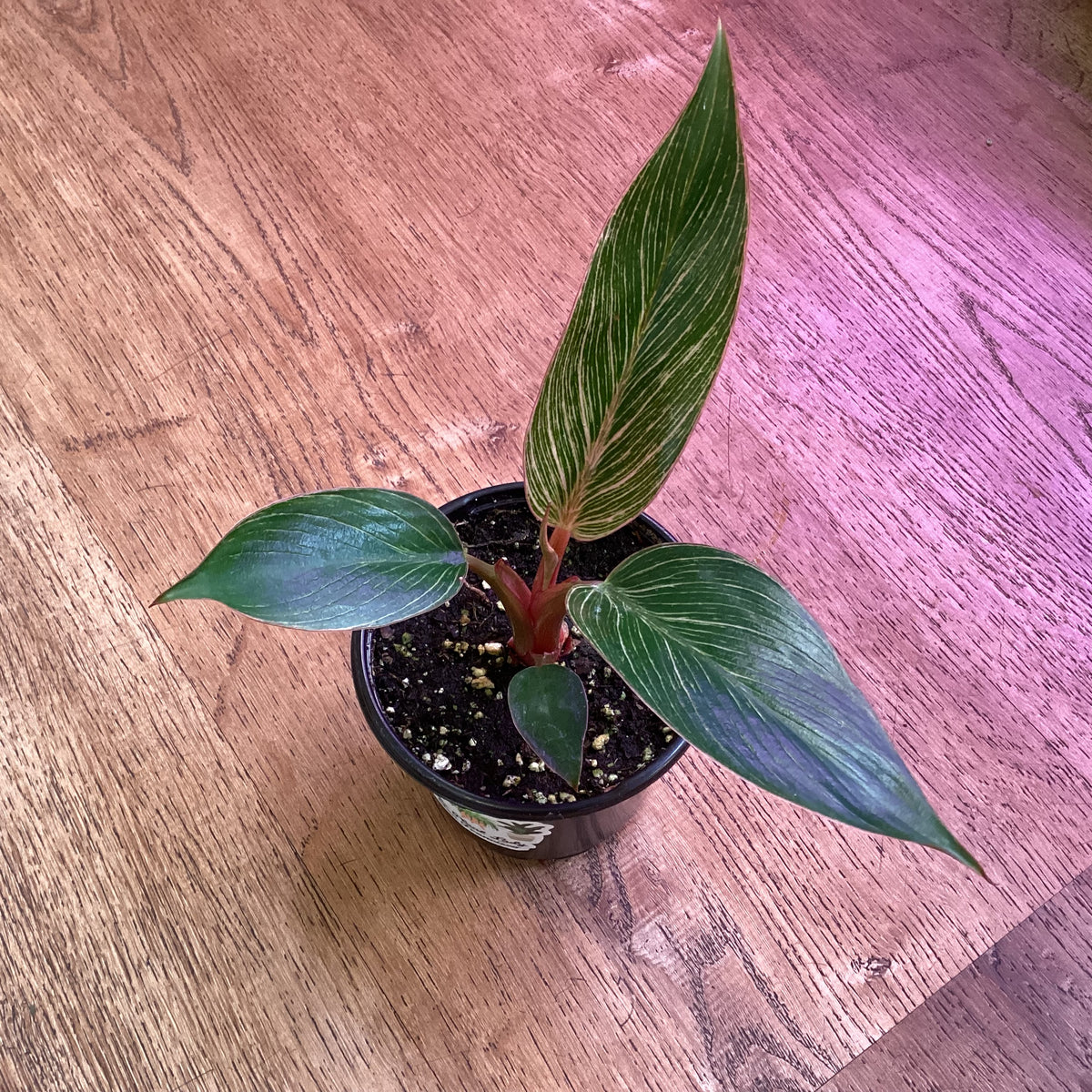
Philodendron "Birkin Pink"
Philodendron "Birkin Pink"
Couldn't load pickup availability
‘Birkin Pink’ is a pink-toned selection associated with Philodendron ‘Birkin’, itself widely understood to have originated as a spontaneous mutation of a red Congo-type Philodendron. New leaves may emerge coral, rose, or pale pink before developing fine cream-colored pinstripes and deeper green tissue. Because Birkin-type variegation is inherently changeable, individual leaves can vary dramatically, and plants may occasionally produce nearly white, solid green, heavily pink, or red Congo-like growth. ‘Birkin Pink’ is used as a horticultural trade name, but a well-documented breeder history or formal cultivar registration is not readily available. Pink expression should be appreciated as a variable characteristic rather than guaranteed on every future leaf.
Care Overview
Light: Provide bright, gentle light to support compact growth and colorful variegation. An east-facing window or filtered south- or west-facing exposure is ideal. Too little light can produce greener growth, while harsh direct sun can scorch pale or pink tissue. A grow light can help maintain consistent growth during the Bay Area’s darker winter months.
Water: Water thoroughly when the upper 1–2 inches of the growing medium have dried. Let excess water drain completely, and never leave the pot standing in water. Birkin-type Philodendrons tolerate a brief dry-down better than constant saturation, but repeated severe drought can produce small, distorted, or damaged new leaves.
Humidity: Average household humidity is usually sufficient, although approximately 50–70% encourages smoother leaf emergence and healthier growth. San Francisco’s naturally moderate humidity is generally favorable. A humidifier may be useful in heated rooms or warmer, drier parts of Oakland and San Jose, but good airflow remains important.
Soil: Use a loose, well-draining aroid mixture containing quality potting mix or coco coir, fine orchid bark, and perlite or pumice. The mix should retain some moisture while allowing air to reach the roots. Choose a pot only slightly larger than the root system, since oversized containers remain wet too long.
Temperature: Maintain approximately 65–85°F and protect the plant from temperatures below 55°F. Keep it away from cold windows, exterior drafts, and heating vents. It may spend warm weather outdoors in bright shade, but Bay Area nights are often too cool for dependable year-round outdoor growth.
Growth Habit: ‘Birkin Pink’ is a compact, self-heading Philodendron rather than a true trailing vine. Leaves emerge closely around a central stem, creating an upright, layered form. Older plants may develop a visible trunk and occasionally benefit from a discreet stake, but they do not require a moss pole to mature properly.
Variegation: Pink and cream tissue contains less chlorophyll and may grow more slowly or develop brown areas more readily than green tissue. The balance of color is partly genetic and cannot be controlled through light alone. If the plant begins producing entirely red Congo-like or solid green growth, that may represent reversion. Pruning back to the last stem section displaying the desired pattern can sometimes encourage variegated growth, but results are not guaranteed.
Fertilizer: Feed lightly during active growth with a balanced fertilizer diluted to approximately one-quarter to one-half strength every three to four weeks. Apply fertilizer only to moist soil and occasionally flush the pot with plain water to reduce salt accumulation.
Pest Care: Inspect the emerging leaf sheath, petioles, and leaf undersides for thrips, spider mites, scale, and mealybugs. Damage to a tightly rolled new leaf will remain visible after it opens, so early detection is especially important.
Pet Safety: Not pet-safe. Philodendrons contain insoluble calcium oxalate crystals. Chewing the foliage can cause intense oral irritation, drooling, vomiting, and difficulty swallowing in cats and dogs. Keep this plant securely away from pets and small children. See the ASPCA’s Philodendron toxicity guidance.
Share